
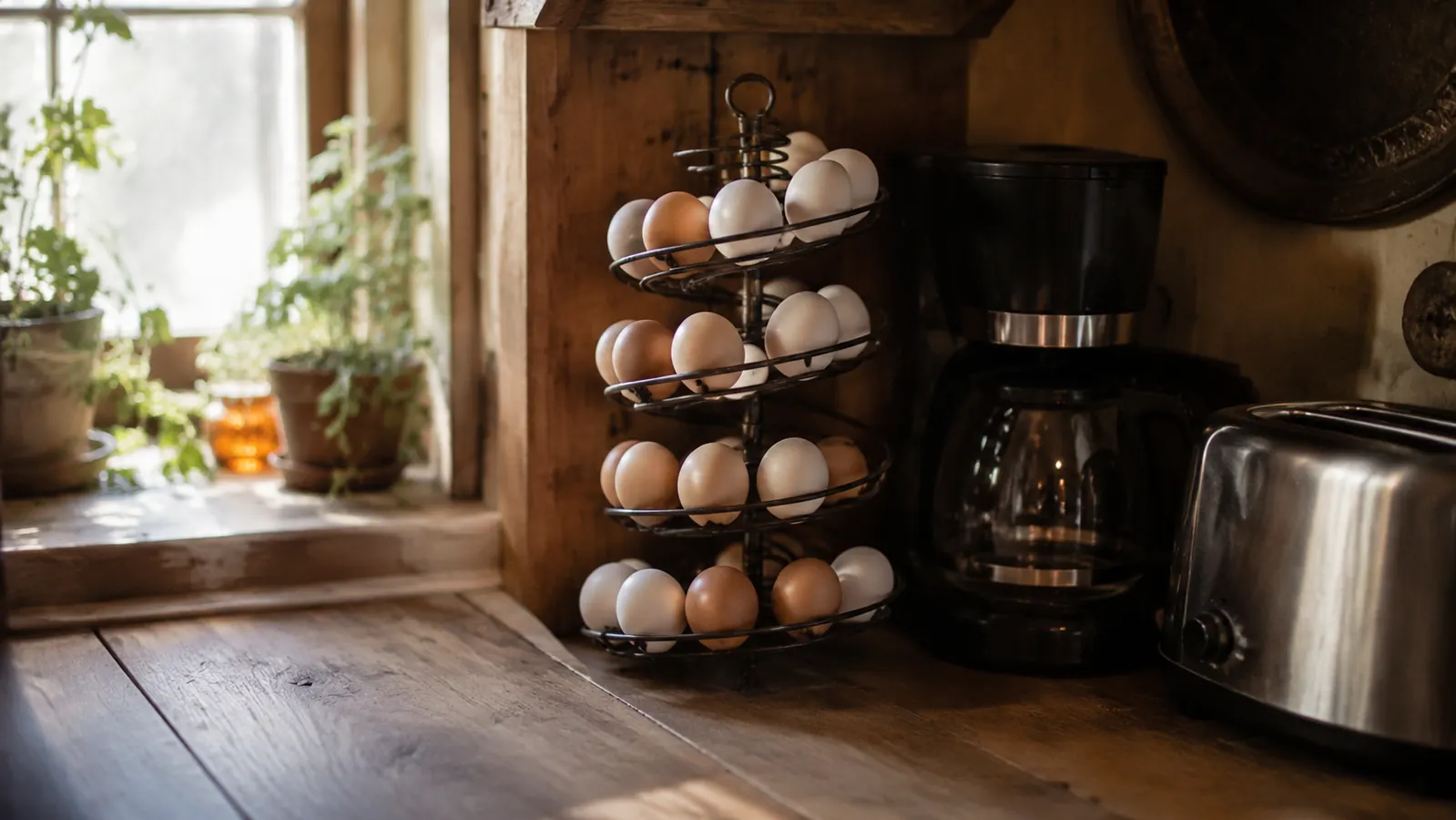
Here's the thing nobody puts in the Toplife egg skelter listing photo: it's smaller than it looks, it holds eighteen eggs and not one more, and the famous first-in-first-out rotation only works if you load it the way it wants to be loaded. I've kept one on my kitchen counter for a full year now, gathering from a dozen hens through two laying seasons and one long, quiet molt, and I like it a lot. I also understand exactly why some folks pull it out of the box, set it on the counter, and feel like they got less than the picture promised. That gap, between the polished listing and the real thing, is what this review is about. I'd rather you know it before you spend your money than find out the way I did, an afternoon in with a counter full of confused eggs.
Most reviews of this thing read like they were typed by somebody who set it up, looked at it fondly for an afternoon, and hit five stars before the first week of real use. That's not nothing, it's a nice piece of metal, but it's not the whole truth. The annoyances are real, they're predictable, and they're the difference between a skelter that becomes a permanent part of your morning and one that ends up in a drawer by September. So let me be straight with you, about the size, about rotation, and about exactly who should hand over their money for one of these instead of leaning on a stack of cardboard cartons.
The Quick Verdict
A compact, dependable counter rack for a small or medium flock, with a first-in-first-out system that really does work if you load it right. The honest fine print is eighteen eggs max, a size that's smaller than the photos, and a track that prefers standard to jumbo eggs. For most backyard kitchens it's a keeper; it is not the harvest display the listing hints at.
Amazon Check Today's Price →The Honest Truth About Size and Rotation
Before you order, here's the reality check most reviews skip: eighteen eggs, a small footprint, and a rotation that needs one simple habit. If you keep a small or medium flock and want the oldest egg front and center every morning, this is the rack I'd start with.
Amazon Check Today's Price on Amazon →How I've Used It
My kitchen sits at the back of a farmhouse that's weathered plenty of Missouri winters, and the counter is where the coffee pot, the dog's food bowl, and every egg that isn't eaten on the spot end up. I keep about a dozen hens, a mix of Reds and an Easter Egger and a couple of old Barred Rocks that still lay every other day no matter the weather. In peak season that's eight to ten eggs a day, sometimes twice a day, and the counter fills up faster than you'd believe.
The skelter sits at the back of the counter, out from under the dogs' noses and away from the sink splash, and every clean, unwashed egg I gather goes into it. I load from the back, I take from the front for breakfast, and when the track is full it holds eighteen eggs that roll forward one at a time. In a year that's a lot of eggs moving down that spiral, and it's the one piece of egg gear on my counter that has never once let me down in actual use.
But here's the honest part of that sentence, the part I want you to hear: it's also the piece of egg gear whose limitations I had to learn the hard way. The size surprised me when I first unpacked it, and so did the way certain eggs refused to roll down the track the way the videos show. If I'd gone in already knowing those two things, I'd have saved myself the better part of a week of fiddling and testing. So let's start with the size, because that's the thing that catches almost everyone.
The Size Nobody Mentions
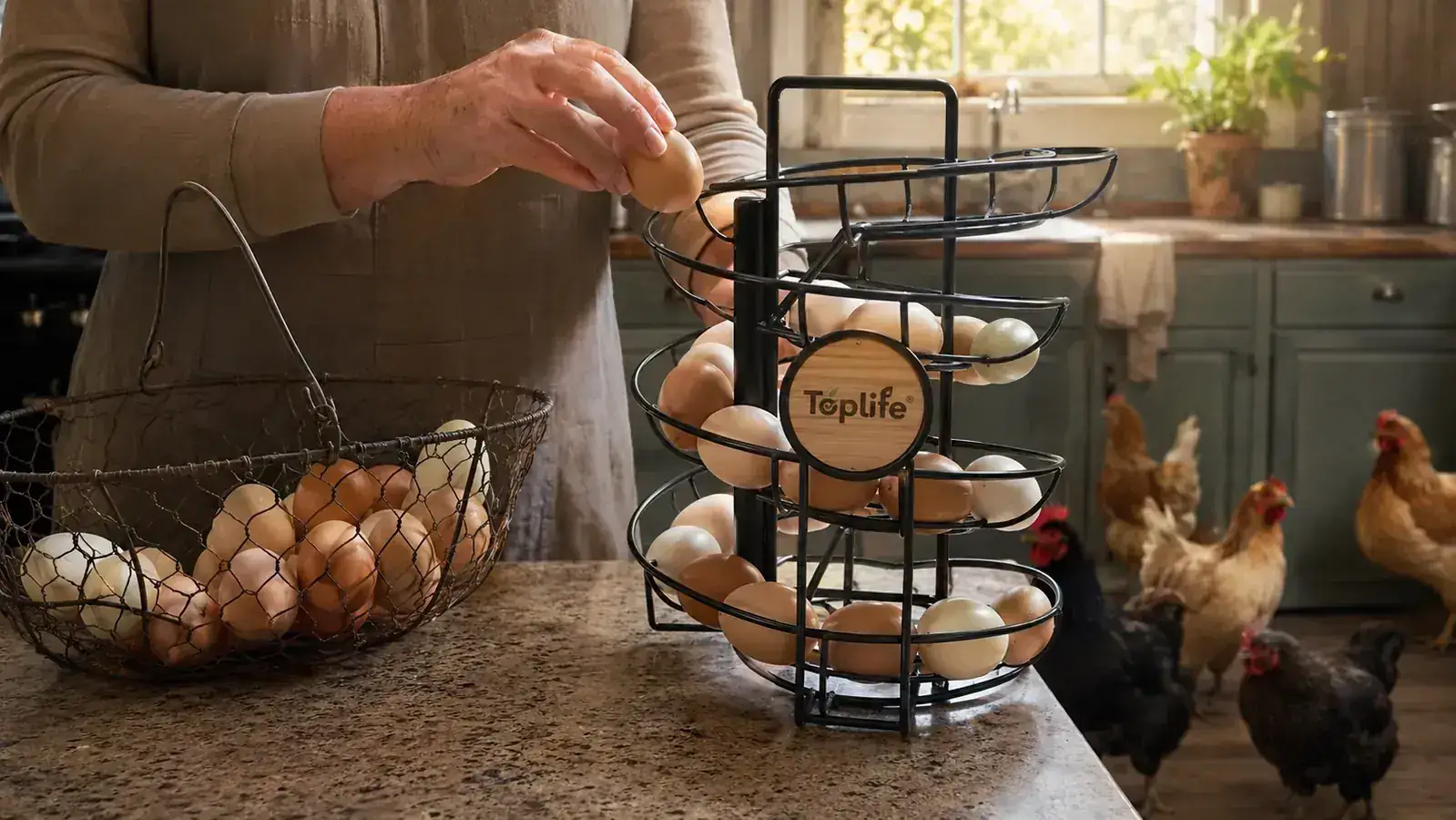
The listing photos make the Toplife look like it holds a couple of dozen eggs and commands a serious stretch of kitchen. It holds eighteen, stacked on their sides up a spiral about the height of a loaf pan, and its footprint on my counter is roughly a foot and a half. That's genuinely compact, which for me is a feature, because my kitchen isn't big and I don't have counter to spare. But it is not the big, commanding display the photos suggest, and if you bought it expecting a harvest showcase, the first glance is going to let you down for about ten seconds.
That gap between the photo and the real thing is the single most common thing people bring up when they ask me about this skelter, so it's worth hearing twice. The camera flatters it. On a real counter, next to a real toaster and a real coffee pot, it reads as a tidy little working tool, not a centerpiece. The good news is the photos undersell how useful eighteen eggs on a small footprint actually is. The bad news is they oversell the presence of the thing. Go in knowing it's a working tool and you'll be perfectly happy. Go in expecting kitchen art and you won't.
Egg Size Matters More Than You'd Think
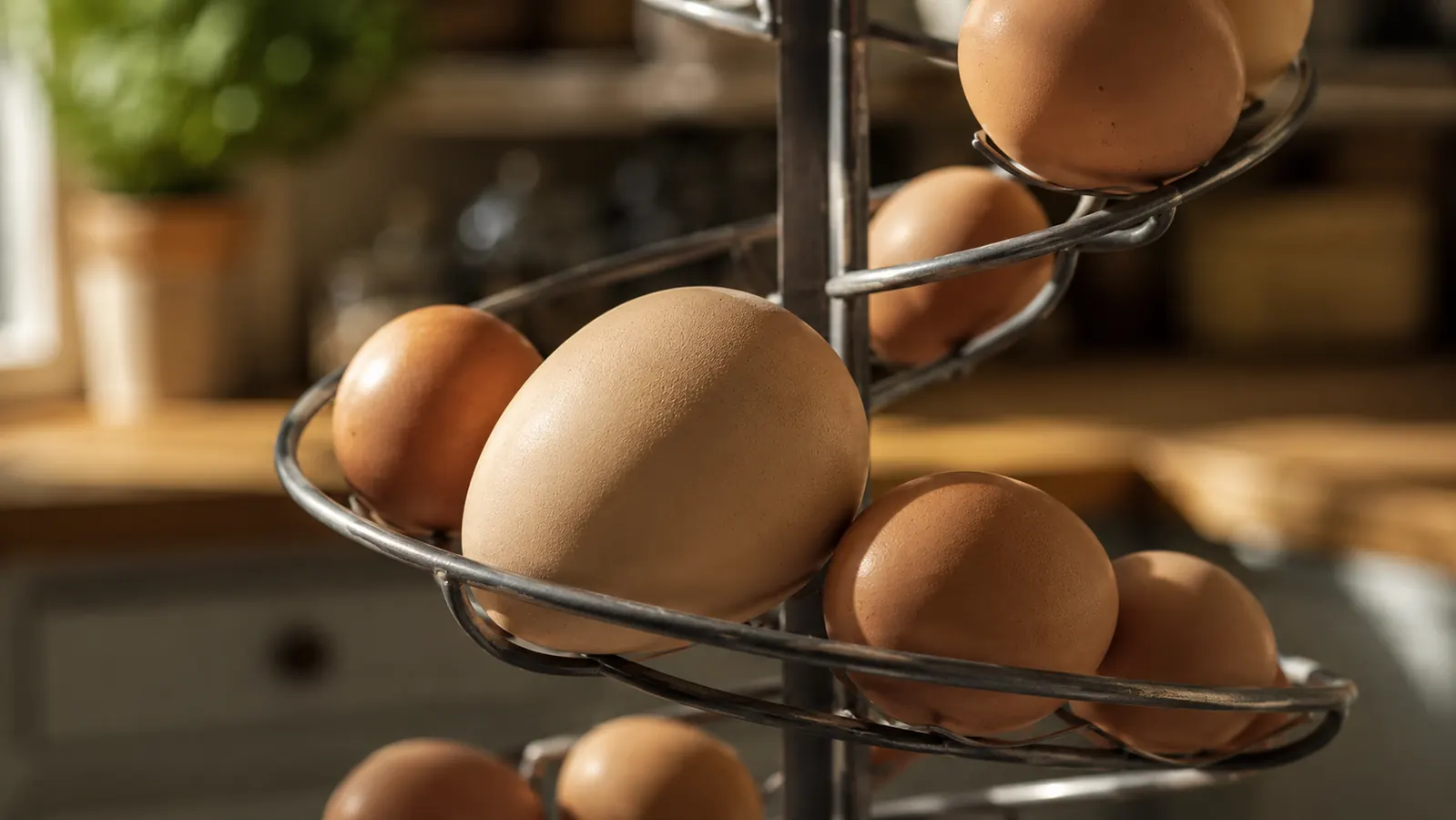
Here's the one that nobody warns you about, and it's the thing that sent me back to the listing to read the fine print twice. Eggs are not all the same size, and the spiral track has opinions about that. My Reds and the Easter Egger lay what you'd call a standard large egg, and those roll down the track one after another, smooth as anything, exactly like the video. Then there are the jumbos, the occasional double-yolker, and those are snug. A genuinely big egg seats itself in the track like it's thinking it over, and it will happily stop the egg behind it.
It's not a dealbreaker, which is the honest part. A big egg that seats awkwardly takes one tap to nudge along, and jumbos are rare in my flock anyway, maybe a handful in a heavy month. But if you keep a breed that lays monster eggs on the regular, or you let your hens free-range into extra-large territory, you'll spend more time straightening eggs than you'd like, and I don't want you to be surprised by that. For standard and large eggs, which is most backyard flocks, it runs exactly the way it's supposed to. Just know the track has a preferred size.
The Rotation Only Works If You Load It Right
The whole point of a skelter is that gravity does the remembering for you, rolling the oldest egg to the front so you never have to think about rotation. That works, and it works beautifully, but only if you load it the way it wants to be loaded. You nestle each egg into the track on its side, from the back, one at a time, and you let the row behind nudge the row ahead forward. If you dump a handful in from the top, which is exactly what I did my first week, they land against each other and absolutely nothing rolls anywhere.
The rhythm, once you've got it, is wonderful, and it's the reason this thing earns its spot. You pick up the front egg for breakfast and the next one rolls down into its place, oldest egg front and center, every single time. In a month where I gather a couple hundred eggs, that rotation is what keeps the two-week-old ones from hiding behind the fresh ones and ending up in the compost bucket. It saves me real money and real frustration, and it's the specific reason I kept the skelter on my counter instead of reaching for a carton.
But it does ask one small thing of you, and I won't pretend otherwise: consistency. The skelter rewards the person who refills from the back and takes from the front, every day. If you're the grab-whatever-looks-biggest type, it's just a pretty rack holding eggs in a line, and that's a disappointment waiting to happen. It's a tool that does its single job beautifully for the routine it wants, and it's honest about that. Meet it halfway and it runs itself. Ignore the habit and you've bought yourself a paperweight.
Eighteen eggs, a foot and a half of counter, and one simple habit of always taking the front egg. That's the whole honest story of what this thing does, and it's enough.
A Morning With It, In Practice
So what does the actual morning look like? I'm up before the sun most days, dogs at my heels, coffee going, and the hens already singing about being fed. I do the coop, gather what's there, and bring the basket back to the kitchen. On a normal spring morning that's eight or nine eggs, still warm, and they go straight into the skelter from the back of the track, oldest eggs at the front getting cooked that same morning.
The beauty of it is that nothing on that counter calls for assembly or batteries or a minute of thought. The Toplife skelter just sits there doing its one job, and I don't have to manage it. When the birds slow down in a molt and I'm gathering two or three eggs a day, the track thins out and the front egg is still the oldest one, which matters more precisely because there are so few to keep track of. A tool that stays useful when the flock is working and when it isn't is, in my book, worth its small patch of counter.
The Base, the Counter, and the Cat
Three small things add up to the honest fine print, and I'd rather lay them out than have you meet them in person. First, the base lifts up with the rack, so you can't take the spiral off and soak it in the sink. I wipe the track down with a damp cloth once a week, and that's always been enough, because a clean, unwashed egg doesn't tend to leak onto the metal. But if you were hoping for a take-it-apart deep clean, this is a wipe-and-move-on piece, and knowing that ahead of time saves you a letdown.
Second, it's light, and the spiral does its best work on a level counter. Mine lives on a surface in a hundred-year-old farmhouse that has settled a touch over the decades, and a full rack of eighteen eggs still rolls along fine, but if your surface is genuinely uneven you may find an egg or two hanging up at the low spot. And third, keep it somewhere a cat, a toddler, or a nosy dog can't reach a full load, because an interrupted spiral is a counter covered in eggs in a hurry. Set it up on even ground, out of reach, and it behaves.
Is It Worth It for Your Flock?
Here's my honest bottom line, and it's the same thing I'd tell a neighbor over the fence. If you keep a small to medium flock, gather a dozen or so eggs a day at peak, and actually cook real meals from them, the Toplife is a genuinely good buy. It takes up almost no room, it makes the oldest egg the obvious choice every single morning, and mine has held up to a full year of daily use with the rose gold finish still looking new. For that, it's one of the best-value pieces of egg gear I own, and I'd buy it again without a second thought.
The honest catch, and it's the whole review in one line, is capacity and expectations. Eighteen eggs is a week's worth of breakfast from a decent flock, not a season's, and if you're gathering thirty or forty a day this thing is overwhelmed by lunchtime. It's also not a display piece, so buy it for what it is: a compact, dependable rotation tool for the kitchen counter. Match that expectation to the reality and you'll be as happy with it as I am. Mismatch them and you'll feel cheated. The skelter isn't the problem. The expectations are.
What I Liked
- Genuinely compact, roughly a foot and a half of counter, so it fits a small kitchen
- Oldest egg rolls to the front every time, so long as you load it one at a time from the back
- The rose gold finish has held up to a full year of daily use without chipping or tarnishing
- First-in-first-out rotation is exactly as good as advertised for standard and large eggs
- Simple enough that a first-time chicken keeper can master it within a week
Where It Falls Short
- Only eighteen eggs, which is small for a big or very productive flock
- Jumbo or double-yolk eggs sit snug in the track and can hang up the line behind them
- The base lifts with the rack, so deep cleaning is a wipe-down, not a soak
- It only rotates for you if you faithfully refill from the back, or the whole idea falls apart
Who This Is For
This is for the backyard chicken keeper with a handful of hens who actually uses the eggs and wants them out where breakfast can find them. It's for the person who's tired of discovering a forgotten carton in the back of the fridge, who cooks from the harvest, and who likes a tool that does one small job without a single moving part that can break. If you keep five hens, or ten, and gather maybe a dozen eggs a day at peak, this fits your counter and your routine like it was made for them.
I'd also hand one to a brand-new chicken keeper on purpose, and that's not a throwaway line. A lot of the early learning curve with hens is rhythm, and the skelter teaches you oldest-first just by sitting there in plain sight. It turns a chore you'd otherwise have to remember into something the rack does on its own. For someone still finding their feet with a first flock, that quiet lesson is worth more than any gadget with a screen and a timer and three modes.
Who Should Skip It
Skip it if you keep a big flock and gather thirty or forty eggs a day, because eighteen won't make a dent and you need real bulk storage, not a counter rack. Skip it if you wash every egg the moment it's gathered, because washed eggs belong in the fridge and a counter rack won't help you at all. And, honestly, skip it if you know, deep down, that you'll never keep the one small habit of taking the front egg and refilling from the back, because without that habit it's just a pretty piece of metal holding eggs the same way a bowl would.
Don't buy it expecting it to hold your whole spring harvest or to light up the room the way the photos do. It's a compact working tool, not a centerpiece, and it says so the moment you open the box. But if you cook from a small flock's eggs and you want the freshest ones front and center every single morning, with the oldest ones right there where you'll use them first, this is the kind of plain, dependable thing that earns its spot on the counter and never gives you a reason to move it.
The Compact Rack I'd Buy Again Tomorrow
A year in, my honest verdict is simple: for a small or medium flock this Toplife skelter is a keeper, and I'd order another one without hesitating. If your fresh eggs deserve better than the back of the fridge, this is the rack that keeps the oldest one front and center on a tiny patch of counter.
Amazon See Today's Price on Amazon →