
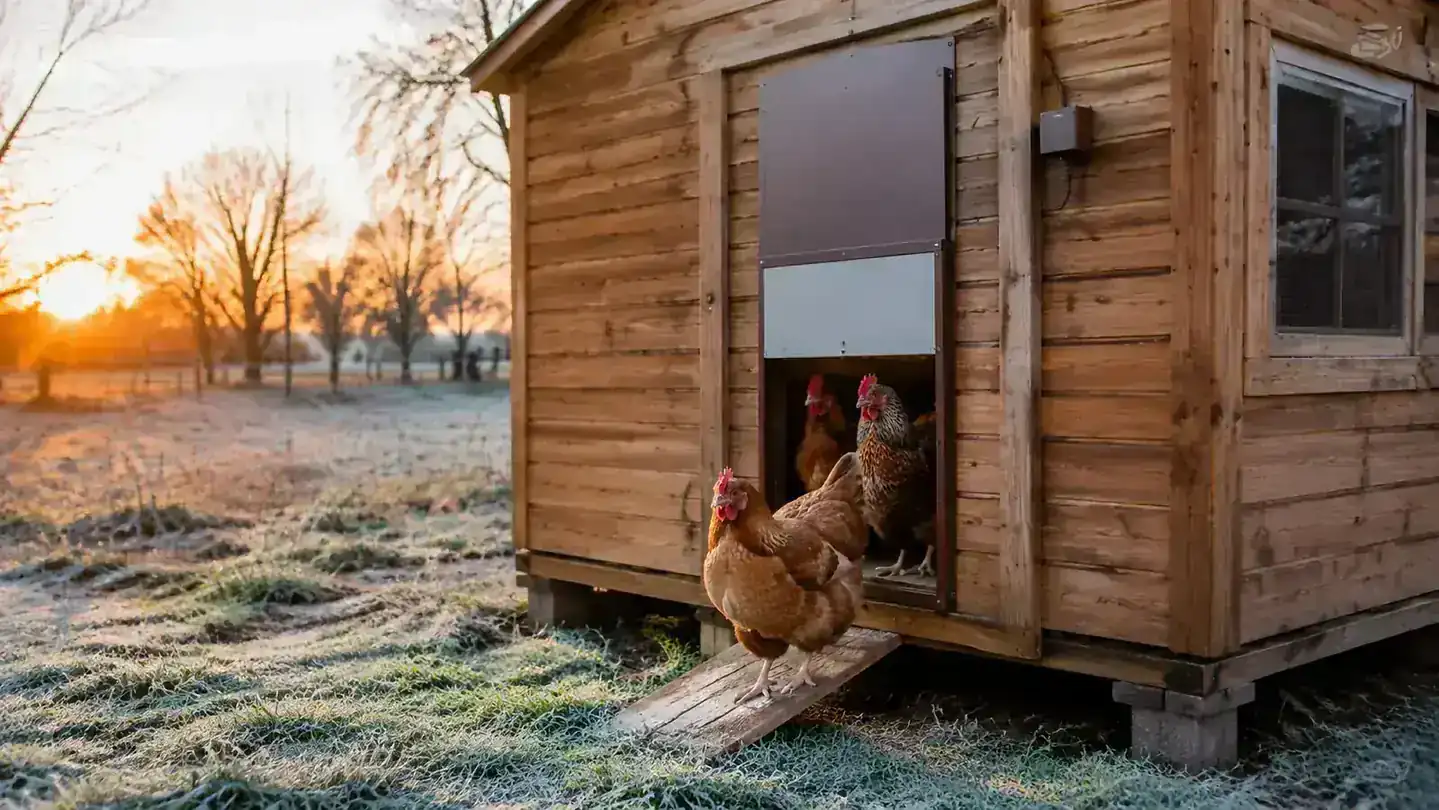
The automatic coop door is the single piece of gear that sounds like a magic bullet and turns out to have a list of small conditions nobody puts in the product title. I get it. You are tired of shuffling out to the coop at dark in February, or you have a raccoon that has learned the exact minute you forget, and a door that closes itself sounds like the answer to every feeding-time problem at once. I have run the RUN-CHICKEN T50 on the side of my main hen house for a full year now, through a Missouri winter, spring storms, and the stretch of 100-degree days we had in July, and I want to tell you where it earns its keep and where it will quietly annoy you.
Because the reviews on this thing are a wall of five stars, and almost none of them mention the bits that actually bite. I am not here to talk you out of an automatic door. I am here to tell you the three or four things I wish someone had told me before I mounted one, so you go in with your eyes open and a plan for the weak spots.
The Quick Verdict
A solid, weatherproof auto door that opens and closes on schedule most of the year, but the light sensor needs a clear sky, the battery wants seasonal attention, and a simpler dusk-to-dawn door might serve a small flock better.
Amazon Check Today's Price →The auto door that closes before the raccoon shows up
If you are ready to stop doing the dark walk to the coop, the RUN-CHICKEN T50 is the reliable workhorse most of the reviews are actually about. See today's price and current stock on Amazon.
Amazon Check Today's Price on Amazon →How I've Used It
I mounted this on the pop-hole of my main coop in September, replacing a homemade plywood slide I had been pulling by hand every night for two years. The coop houses about a dozen hens, a mixed flock of Rhode Island Reds, Barred Rocks, and a couple of Easter Eggers, on the north edge of my property where the trees drop leaves straight onto the roof every fall. My pop-hole faces southeast, which matters more than you would guess, and I will get to why.
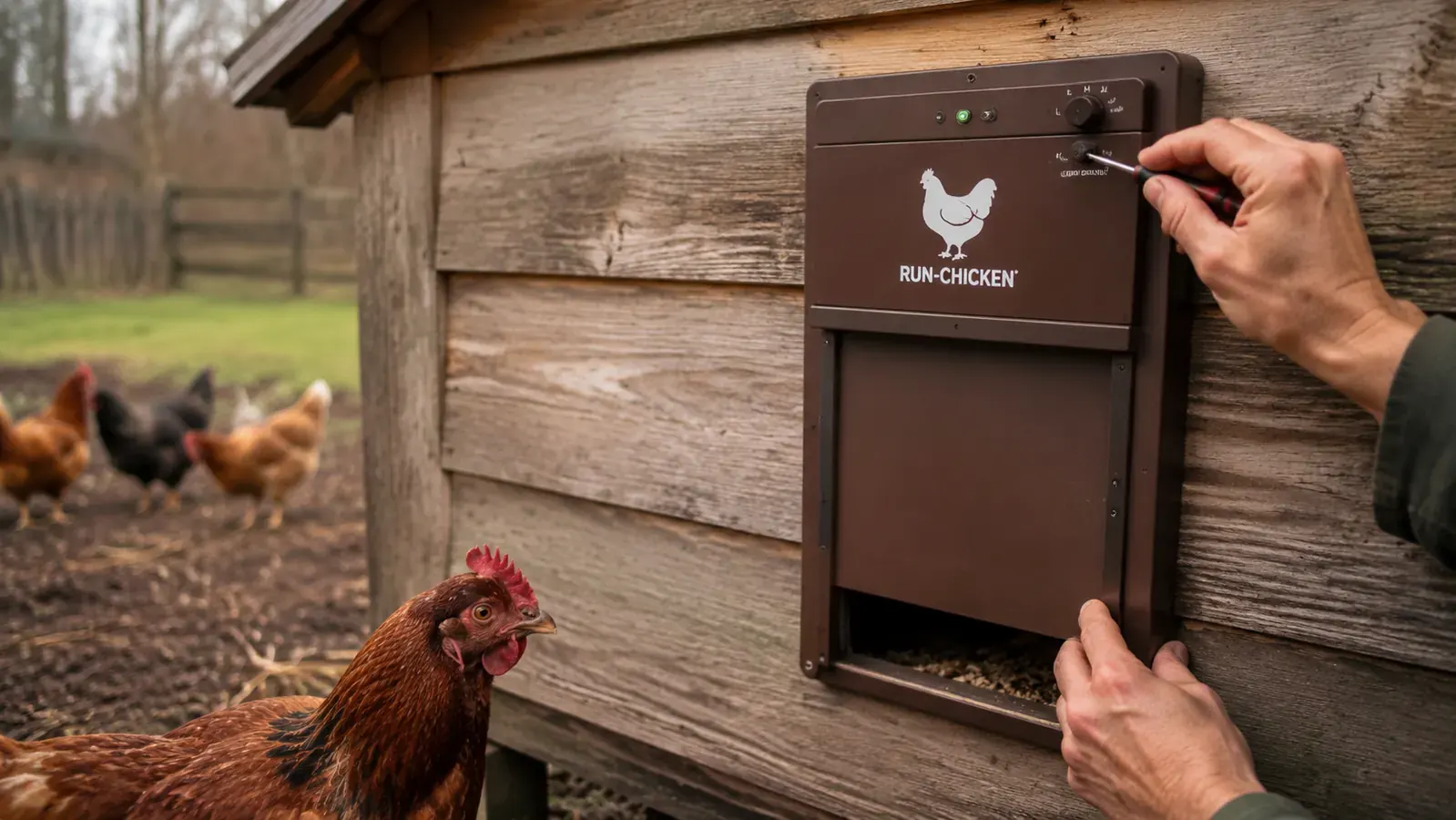
The T50 is the battery-powered model. It takes four C batteries and runs on a light sensor by default, which is the mode I used all year. It also has a timer mode and an app connection over Bluetooth, and I played with the app early on before settling back to the plain light sensor, because for a small flock the sensor just plain works the way my day works. Sun up, door up. Sun down, door down. That is the whole job, and it does that job well.
Installation took me about an hour on a Saturday morning. It mounted flush to the outside of the coop and the sensor arm, which is the part that looks like a little antenna, threads through the wall to the inside. The rail that the door slides in was solid aluminum, the gearbox felt tight, and the whole thing came with the screws and a template for drilling. I have mounted a fair amount of coop hardware in my life, and this was one of the easier installs.
The day the door failed to close was a clear, still evening with a muddy sensor lens and a few dead batteries. Both were my fault, and the fix took five minutes each. But a door that needs you to remember a lens wipe before a winter storm is not quite the set-and-forget gadget the listing implies.
The Sensor Wants a Clear Sky
Here is the first thing the five-star reviews bury. The T50 decides when to close by watching the light, and it is tuned for an unblocked view of the sky. On my southeast-facing wall that is fine, mostly. But in the fall and spring, when a storm rolls in and the sky goes gray by four in the afternoon, the door has closed early on me more than once. On those days the flock was still out scratching and had to sit on the ramp until I opened it again, and a hen who is not in the coop at dusk is a hen who is one hawk or dog away from trouble.
The bigger headache is the lens itself. The sensor sits in a little housing on the mounted rail, and over a wet winter it collects grime, frost, and the occasional smear of leaf juice from the trees overhead. A dirty lens reads less light, so the door starts closing mid-afternoon on days it should stay open. I learned to give the lens a wipe clean at the start of any big weather system, and once I did that, the false closures stopped. But it is maintenance, and it is maintenance the listing does not warn you about.
If your coop faces a brightly lit wall, sits under a dense evergreen, or gets afternoon shade, budget time for the timer mode instead of the sensor. The timer is simple to set and removes the storm-cloud guesswork entirely, at the cost of drifting a few minutes as sunrise and sunset move through the year. Pick one and commit. Switching between modes every week is how mistakes happen.
Batteries Are Not Set and Forget
The T50 runs on four C batteries, and the math matters. In the warm months, cold weather pulls the voltage down, and a door that is opening and closing in January in below-freezing air is working harder than the same door in June. My first set of batteries died at the worst possible time, on an evening in late November, and the door froze half-closed with the gearbox straining against a crust of ice. I came out to find the pop-hole three-quarters shut and a hen wedged on the edge looking at me like this was my fault. It sort of was.
The fix is boring and cheap: swap the batteries twice a year, spring and fall, on a schedule, not when the door stops. That is it. The instruction manual says the low-battery light tells you, and it does, but the low-battery warning on a cold morning reads exactly like a door that is just running slow. Do not wait for the light. Put a reminder in your phone for the equinoxes and change them whether the door thinks it needs it or not.
What Snow and Ice Actually Do to It
I read a lot about the T50 before I bought it, and the phrase that came up over and over was all-season performance. Let me be precise about what that means after a real winter, because it is not the whole story. The aluminum rail sheds snow beautifully, and the gearbox has enough torque to push through a light skim of frost on the track. On the three or four heaviest ice storms we had, though, I still had to clear the track before evening so the door could seat fully. Ice that builds into a crust along the bottom edge will stop the door short of closed, and a door that stops at ninety percent might as well be open as far as a determined raccoon is concerned.
There is a setting that holds the door against the stop for a few extra seconds to seat it, and I recommend turning it on. It is a small thing that makes the difference between a door that closes flush and one that leaves a nose-sized gap. Still, plan for a ten-second track check on freezing afternoons. That is not the gadget failing. That is winter being winter, and any automatic door is going to ask you for it.
The App, the Manual Override, and the Everyday Routine
The T50's Bluetooth app is the part I want to be honest about, because it is neither the selling point the box makes it nor the useless add-on some reviews claim. I connected it once on install, set the door to my schedule, and checked it again after a week out of curiosity. It works for peeking at whether the door is open or closed and for flipping between sensor and timer from the kitchen, which is genuinely nice on a wet morning when you do not want to walk to the coop in your robe. But it is Bluetooth only, so it only reaches from the house to the coop, and it is not a long-range remote. I stopped relying on it as soon as I realized that.
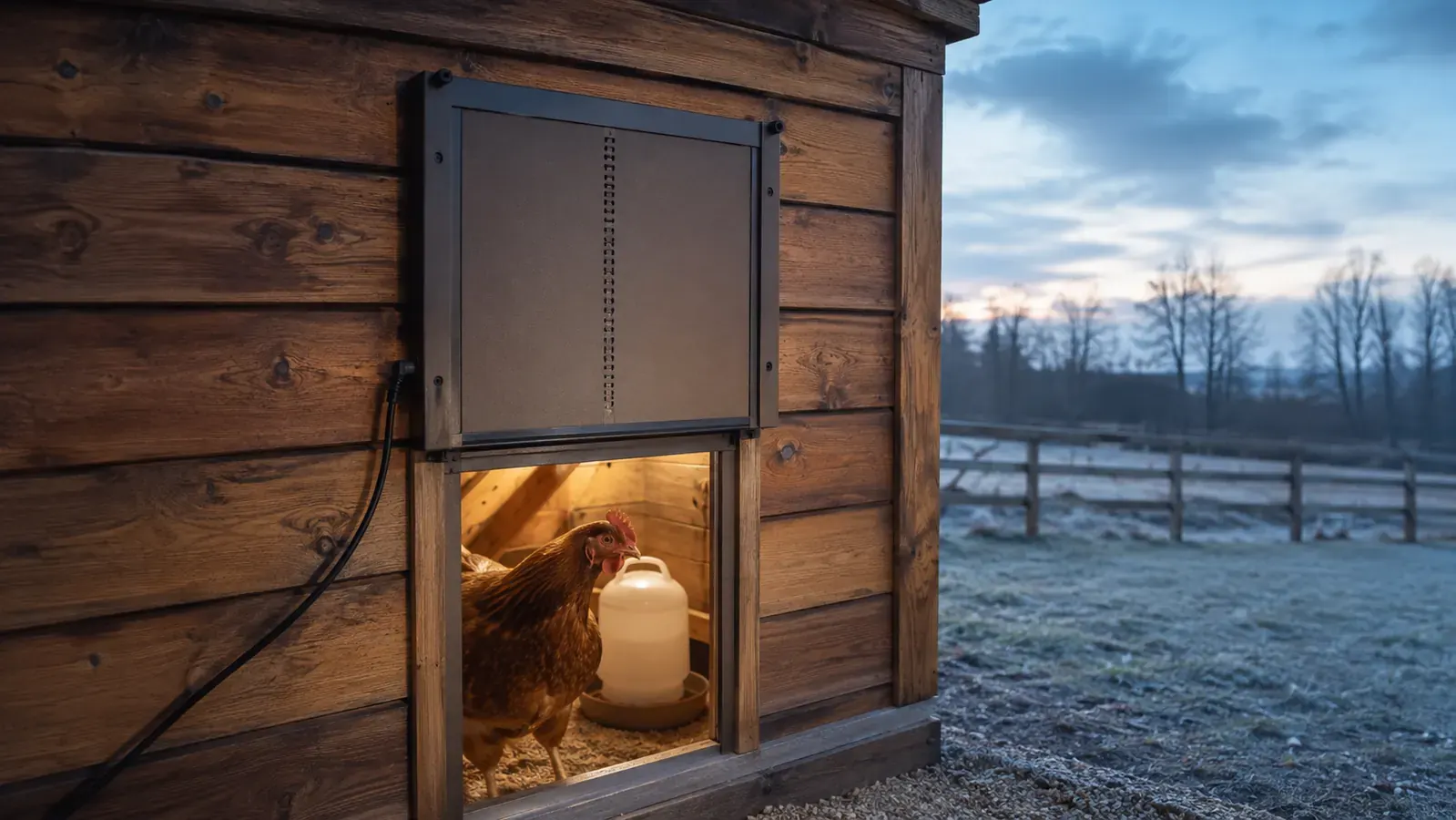
The manual override is the piece that matters more than the app, and it is simple the way farm tools should be. There is a release pin that lifts the whole slider out of the rail by hand, so on the rare days a hen gets locked out or a battery dies mid-cycle I can raise the door without tools and without fighting the gearbox. I have used that pin exactly three times in a year, and the fact that it exists has saved me from crawling around in the shavings each time. A door you cannot open by hand when it fails to run is not a convenience, it is a trap, and the T50 does not have that problem.
My everyday routine with this door is embarrassingly simple now. In the morning I walk out with the coffee, open the run, and let the door do its own thing. In the evening I let it close itself and trust it. Compared to the old plywood slide, which I had to remember, check, and occasionally rebuild, the T50 has quietly taken the worst chore off my list. That is the real value of it, and it holds up even with the sensor and battery quirks above, as long as I treat it like a farm tool that needs a little maintenance instead of a toy that never does.
What I Liked
- Thick aluminum sliding rail that does not flex or loosen after a year of daily use
- Strong gearbox with enough torque to push through frost, plus a seat-and-hold close setting
- Battery powered, so there is no wiring run and it works through a power outage
- Light sensor, timer, and app modes give you a real choice in how it triggers
- Straightforward install with a good template and solid hardware
Where It Falls Short
- Light sensor closes early on overcast or stormy afternoons unless you use timer mode
- Sensor lens collects grime and frost and needs routine wiping before big weather
- Batteries need twice-yearly replacement on a schedule, or a winter failure catches you out
- Track can still ice up on the heaviest storms and needs a quick pre-dusk clear
- All that weatherproofing and torque pushes the price well above a basic timer door
Who This Is For
The RUN-CHICKEN T50 is at its best for someone with a flock of a few birds to a dozen, a coop on an open wall where the sensor can see the sky, and enough routine to remember two battery changes and the occasional lens wipe. If you travel or work shifts that keep you away at dusk, the automatic closure is a genuine safety net that will save you from your own forgetfulness more times than you count. It is also the right tool if you have a specific predator that has figured out your evening routine, because a door on a sensor does not get tired and does not lose track of time.
For eleven months out of the year, this door opens and closes on its own and I do not think about it once. The twelfth month is February, and February is when you remember it is a machine with batteries and a lens.
Who Should Skip It
If your coop faces a bright wall or sits under heavy tree cover, the sensor is going to fight you, and you should either plan to use timer mode from day one or pick a simpler dusk-to-dawn door without the app and the sensor to fuss with. If you keep four hens in a small coop and you are home every evening at a regular time, an automatic door of any kind may be more gadget than you need, and the T50 is one of the pricier ways to solve a problem you do not really have yet. And if you are the kind of keeper who wants to mount it and never touch it again for three years, no automatic coop door on the market right now is going to give you that, this one included.
The Bottom Line After a Year
I have kept my flock alive through a Missouri January, a nightly raccoon that patrols the fence line, and my own occasional laziness about the dark walk, and the RUN-CHICKEN T50 has been a genuine help in all of it. The build is the best I have handled in this price range, and the automatic closure has caught a predator window more than once. But the honest review is that it asks a little of you in return: a clear view for the sensor, a battery swap on a schedule, and a track check on the worst winter nights. None of that is hard. It is just more than the five-star wall lets on.
Go in knowing the weak spots and the T50 is a strong buy for an active keeper. Go in thinking it is a set-and-forget miracle and you will be the one out at dusk in February, wiping a lens, wondering why nobody mentioned it. Now you know why. It earns its place in my coop, and it was worth what I paid, but it earns it with two battery changes a year and a little winter manners.
Ready for fewer dark walks to the coop?
The RUN-CHICKEN T50 is the most reliable automatic door in its class once you know its quirks, and now you do. Check today's price and stock on Amazon before you decide.
Amazon See Today's Price on Amazon →