
A rat can duck through a gap the width of a pencil eraser, and it will find a pound of spilled layer pellets before you find the hole it came in through. I learned this the hard way in October of 2024, the week I came out to the coop at dusk and watched a pair of them hop right into an open hanging feeder and eat their fill while my hens stood two feet away, too slow to be bothered. If you have chickens, you have a rat problem on your hands. You just might not have seen it yet. The good news is the whole thing turns on one idea: rats do not live off open food bowls, they live off what you leave out. Take away the free dinner and the rats have to move on.
I'm Rosie Callahan, and I keep a dozen hens in rural Missouri. I have spent more evenings than I want to count with a flashlight and a shovel trying to out-think a rat that was always one meal ahead of me. This is the exact routine I settled on, in the order that actually worked, centered on the Grandpa's Feeders treadle feeder that finally ended the whole cycle for good. None of it is glamorous, and none of it takes a single hardware store gadget that looks clever but dies in the rain.
Stop the nightly buffet before the rats settle in
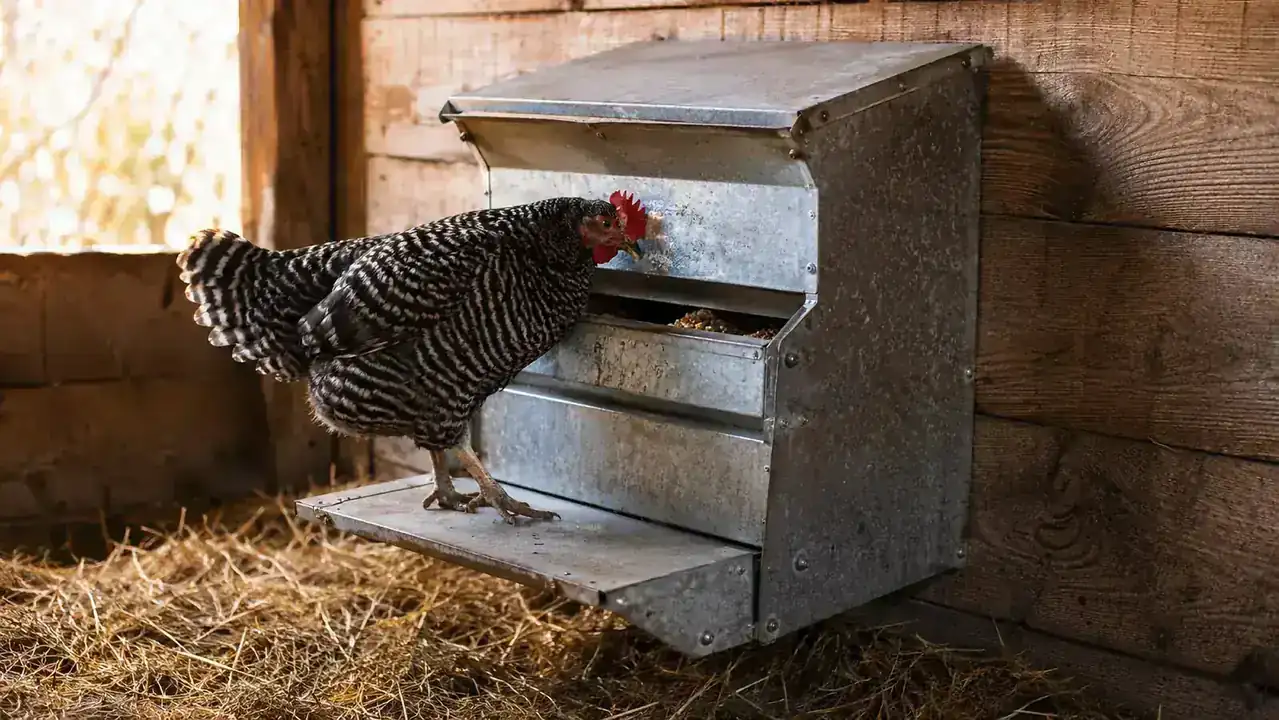
The single biggest change I made was putting the feed where only the hens can reach it. The Grandpa's Feeders treadle feeder uses a counterweighted treadle plate, so a hen steps on it to open the lid and a rat's weight closes it. That one swap broke our cycle in under a week.
Amazon Check Today's Price on Amazon →Step 1: Tear down the open feed bowls first
Do this before anything else, because nothing else matters while a rat can eat without working for it. Walk your property and ask yourself one question at night with a flashlight: where is grain sitting out where I cannot reach it fast? For me it was a crusted rubber bowl of pellets I kept in the run for the younger hens because the adults bullied them at the big feeder. That bowl was a restaurant with a reservation sign, and the rats were the only ones reading it.
Remove every open dish, every trough, and every bowl, and stop refilling them out of habit. If you free-range, pick up any food you put out before dark, because dusk is prime rat hour. I moved to feeding only inside the covered coop, which meant the birds had to come in to eat and I could see exactly what was on the floor when I latched the door each night.
Do not expect the rats to vanish the day you remove the bowls. Give them a few nights of walking into an empty coop. What you are doing here is removing the reward, which is the part of the problem that actually feeds the population. A hungry rat will investigate. A starving one leaves.
Step 2: Pick up the spill before it becomes a trail
Most rat problems are really spilled-feed problems wearing a costume. Chickens scratch, and a hanging feeder that gets banged around all day throws a surprising amount of grain onto the floor. I was stunned the first time I swept the run after a single day with a busy flock and came up with a coffee-can-full of pellets that I had effectively paid to dump on the ground for the rats.
Stop overfilling your feeder, because the feed spilling out of a full hopper is a trail you are laying yourself. I used to fill the big hanging tube to near the brim to save trips. That was me fattening rodents out of laziness, and I will not pretend otherwise. Fill it halfway so there is less spill, and sweep the coop floor at least once a day. I do my sweep when I close up at night, which is also when I check for the next problem on this list.
If your feed area is on dirt, consider a piece of stall mat or a concrete pad under the feeder. It gives the rats nothing to dig under and makes the sweep trivial. This is a ten-minute job and it cuts the spill problem in half before you ever touch the fancy feeder.
Step 3: Put the feed where a rat's weight cannot open the door
This is the step that finally worked for me, and it is where I stopped trying to poison my way out of a structural problem. I switched to the Grandpa's Feeders automatic treadle feeder, a 20 pound capacity galvanized steel unit with a counterweighted treadle plate. Here is the trick that makes it rat-proof: the birds do not peck at an open bowl of pellets, they step onto the treadle platform, their body weight pushes it down, and that motion lifts the protective lid. A rat, at roughly a quarter of a hen's weight, cannot push the plate down far enough to open it.
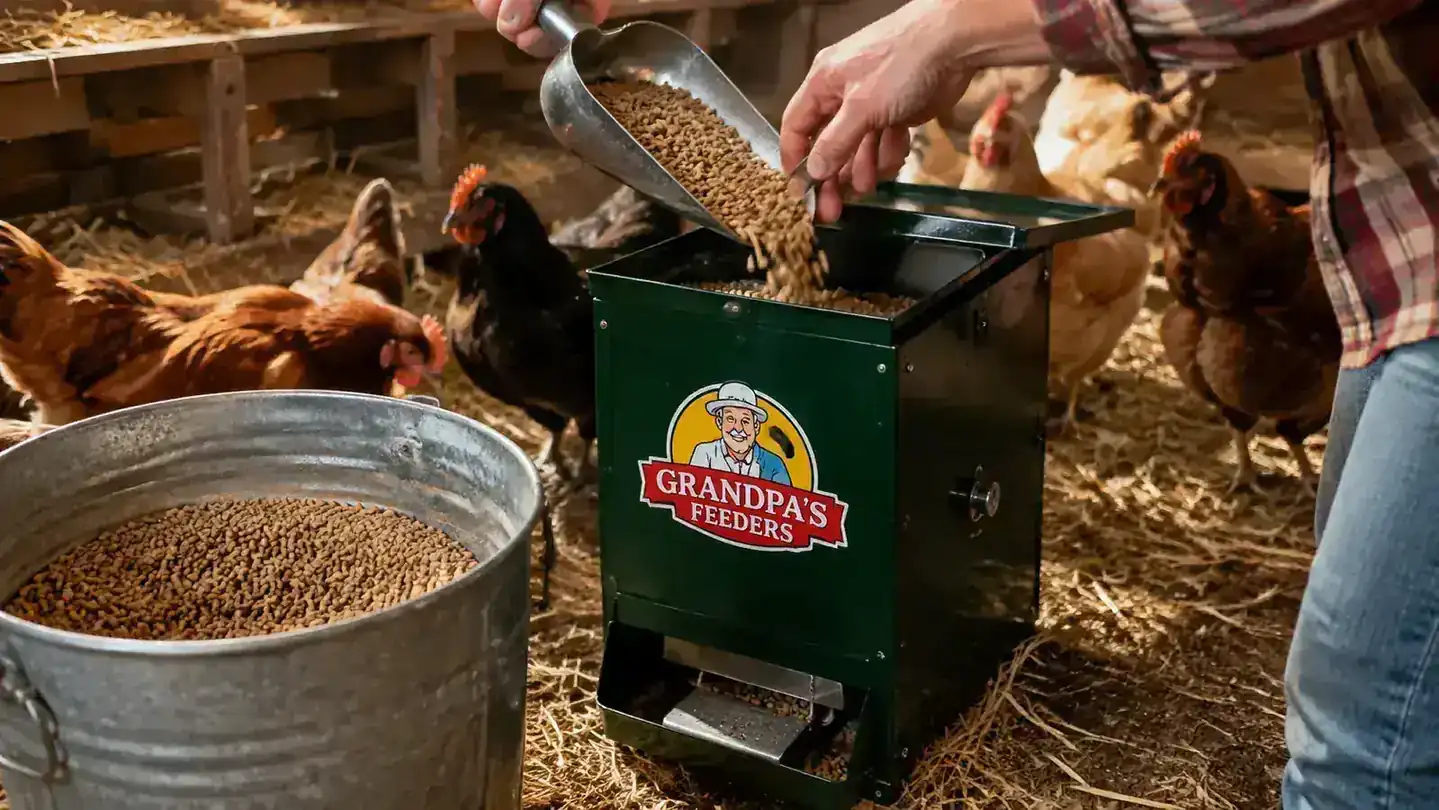
It took my hens about three days to figure the treadle out, and that was with an older flock that did not take to change quickly. I helped the first one by setting her directly onto the plate with a sprinkle of feed on it so she felt the lid open under her feet. After that, the rest learned by watching her. The Grandpa's Feeders holds 20 pounds, which feeds my dozen hens for about a week without me refilling it, and because the lid closes the moment they step off, the pellets stay dry and the rats stay out.
The real proof came about five days in. I sat in the truck with the headlights off at dusk and watched the same two rats that used to hop into my open feeder circle the treadle, hop onto the plate, get nowhere, and leave. They tried it three nights in a row and then they were gone from that corner of the yard entirely. A rat will not fight a locked door for very long when there is easier pickings elsewhere.
Step 4: Close the gaps a rat can squeeze through
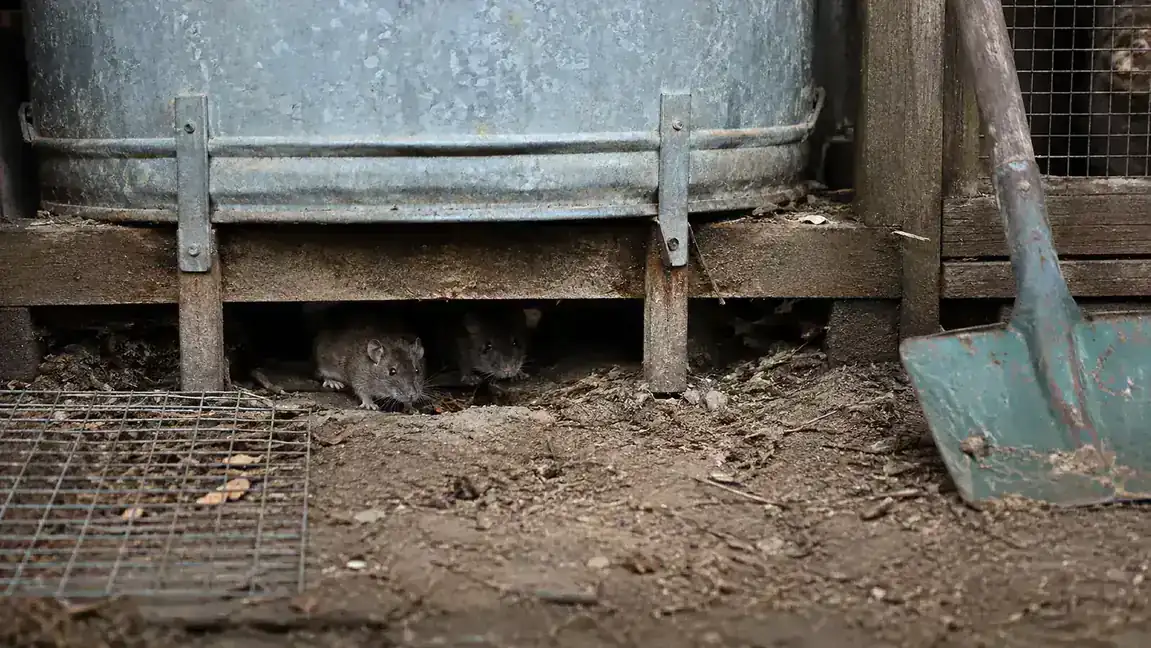
A rat does not need much of an opening to get into your coop, and once you take the feed away, it will go looking for what it can reach. This is the part of the job nobody likes, because it means getting on your hands and knees with a flashlight and looking at your own coop like a thief would. Check where your skirting meets the ground, around the door frame, under the ramp, and where the wall meets the roof. Any gap you can fit your thumb through is a doorway for a rat, and many of them need less.
I patched every gap I found with hardware cloth cut to size and screwed over the opening, plus a rolled layer of dirt and gravel tamped along the outside of the skirting so nothing could dig under. Galvanized hardware cloth with 1/2 inch or smaller mesh is the right material, and it will outlast the coop. Do not bother with chicken wire for this. A determined rat will chew through it.
Do this the same week you swap the feeder, because the two go together. The treadle feeder cuts off the easy food, and the gap-closing cuts off the last resorts, which is how you push a resident rat population from annoyed to gone instead of just mildly inconvenienced.
Step 5: Keep the place rat-uninteresting for the long haul
The last piece is a habit, and it is the piece that keeps the work from undoing itself. Rats are creatures of routine, and they are drawn to a dependable food source. If you leave the coop uninteresting for a solid month, they find somewhere else to set up. That means the swept floor, the closed feeder, the patched gaps, and no grain sitting out overnight, every single night, not just the week you got motivated.
I also stopped keeping the bag of feed open in the barn where the rats could gnaw the corner. Layer pellets now live in a lidded metal trash can with the bag rolled closed inside, and I do not leave scoops or buckets of grain sitting on the barn floor where a rat can reach them overnight. It sounds obvious, but I have met more than one chicken keeper who mopped up a whole rodent problem and never noticed the torn feed bag three steps from the coop door was re-seeding it nightly.
What Else Helps
Once the free food is gone, a few extras make the job go faster. A good barn cat of the mousing variety will patrol the perimeter for you. I keep two rescue dogs and they do not hunt, so I borrowed my neighbor's barn cat when things were at their worst and the rat sightings dried up noticeably in two weeks. You can also set a few snap traps along the run walls with the bait side facing the wall, which chases a rat into the bait instead of letting it see you coming. Facing the trap toward the wall is the move, because rats run the wall and a trap facing out into the open reads as a hazard.
What I would not do is start with poison. Poison works, but it also kills owls and hawks and the neighbor's dog if a poisoned rat dies somewhere a predator finds it before you do. On a place with horses, dogs, and free-ranging hens, I will never put a carcass risk like that in the middle of my own yard. If you absolutely must use poison, keep it in a locked bait station a rat can get into but a dog or a hen cannot, and pick up dead rats every morning before the dogs get to them first.
A rat will not fight a locked door for very long when there is easier pickings elsewhere. Five days after the treadle feeder went in, the ones that used to eat at the open bowl were gone from that corner of the yard.
How Long Until It Actually Stops
I want to be honest about the timeline, because every article that promises overnight results is lying to you. The Grandpa's Feeders treadle feeder is not a switch that flips the moment it lands on your porch. Give your hens a few days to learn the treadle, give the settled-in rats a couple of weeks to understand that their reliable dinner is gone, and expect the stray young rat to keep poking around for a month before it gives up and moves on. My batch of visibly resident rats was gone in about three weeks, and we have not had a confirmed sighting inside the run since.
The principle is what matters and it never changes: rats follow the feed. Take the feed away, close the door on the last detail, and the problem does not so much get solved as it gets outgrown. The feeder does the heavy lifting, and the habits I listed here are what keep the work from quietly undoing itself every spring when the weather warms up.
Give the rats a reason to leave and never come back
Three weeks of clean, closed-up feeding ended a problem I had been fighting for a season. If you are tired of finding shelled kernels and rat droppings in your shavings every morning, the same treadle feeder is worth a try. It is built out of galvanized steel that survives Missouri weather, holds a week of feed for a dozen hens, and costs nothing per night once it stops the waste.
Amazon Check Today's Price on Amazon →